Evaluation website: http://courtneyodonnell97.wix.com/mediastudies
Final opening sequence:
OTS Final from Courtney O'Donnell on Vimeo.
Preliminary task:
Continuity task final edit from morrighan humpleby on Vimeo.
Wednesday, 2 April 2014

Saturday, 15 March 2014
Feedback for Final Edit
Morrighan has written the post for this, which I have linked here: http://morrighanasmediaproductionsschs2014.blogspot.co.uk/2014/04/final-feedback.html
Sunday, 2 March 2014
Final Stages of Editing: Sound
Music:
For the final stages of editing, Morrighan and I have been adding non-diegetic sound to the final cut of our footage. Morrighan began by recording the film noir, jazz style music for our OTS on her saxophone, which we then imported to iMovie and added over our footage. We cut and and overlapped the music so that it fit in with the footage, and experimented with adding audio effects, but felt that the music sounded best without them.
Monologue:
Next we recorded the monologue which I wrote for our anti-hero actor, Andrew. We used a Marantz and then imported this into iMovie, added it over our OTS footage, and cut and moved the audio so that it overlays appropriate footage for what the monologue is describing. We also added ducking to reduce the volume of other audios while the monologue is playing. This is so the monologue could be heard easily, as it is important that the audience follows it in order to understand the narrative. I planned the placement for the monologue over the footage in this post.
Foley femme fatale dialogue:
The foley sounds we added were the femme fatale's dialogue to clarify it as there was lots of noise in the background, the femme fatale's footsteps for when she is walking in the last scene, and a gunshot sound for when the title appears at the end of the OTS. Morrighan recorded her dialogue as the femme fatale on her phone, and we imported it to iMovie, and replaced the sound from the clip where she originally said this line with the foley.
Foley femme fatale footsteps:

Footstep Foley from Courtney O'Donnell on Vimeo.
I created the foley footsteps by walking on a hard wooden floor in high heeled shoes to mimic the femme fatale walking on concrete in heels. I recorded this onto my phone, uploaded it to Vimeo, downloaded it onto the computer where we are editing our OTS, and then imported it into iMovie. Then we added it over the clips where there are footsteps, cutting out the gaps in the audio where there was no sound, so that noise was not added to the clips unnecessarily. I edited the audio by reducing the noise, adding the audio effect 'pitch down', and decreasing the volume by 25%.
Foley gunshot:
Finally, we used the stapler gunshot sound which we created in our foley experiment video for the end of our OTS. I used clip trimmer to remove the click at the end of the sound, and then slowed it down so that the trimming did not make the sound too short. I added this to our OTS in time with when the film title appears.
For the final stages of editing, Morrighan and I have been adding non-diegetic sound to the final cut of our footage. Morrighan began by recording the film noir, jazz style music for our OTS on her saxophone, which we then imported to iMovie and added over our footage. We cut and and overlapped the music so that it fit in with the footage, and experimented with adding audio effects, but felt that the music sounded best without them.
Monologue:
Next we recorded the monologue which I wrote for our anti-hero actor, Andrew. We used a Marantz and then imported this into iMovie, added it over our OTS footage, and cut and moved the audio so that it overlays appropriate footage for what the monologue is describing. We also added ducking to reduce the volume of other audios while the monologue is playing. This is so the monologue could be heard easily, as it is important that the audience follows it in order to understand the narrative. I planned the placement for the monologue over the footage in this post.
Foley femme fatale dialogue:
The foley sounds we added were the femme fatale's dialogue to clarify it as there was lots of noise in the background, the femme fatale's footsteps for when she is walking in the last scene, and a gunshot sound for when the title appears at the end of the OTS. Morrighan recorded her dialogue as the femme fatale on her phone, and we imported it to iMovie, and replaced the sound from the clip where she originally said this line with the foley.
Foley femme fatale footsteps:
Footstep Foley from Courtney O'Donnell on Vimeo.
I created the foley footsteps by walking on a hard wooden floor in high heeled shoes to mimic the femme fatale walking on concrete in heels. I recorded this onto my phone, uploaded it to Vimeo, downloaded it onto the computer where we are editing our OTS, and then imported it into iMovie. Then we added it over the clips where there are footsteps, cutting out the gaps in the audio where there was no sound, so that noise was not added to the clips unnecessarily. I edited the audio by reducing the noise, adding the audio effect 'pitch down', and decreasing the volume by 25%.
Foley gunshot:
Finally, we used the stapler gunshot sound which we created in our foley experiment video for the end of our OTS. I used clip trimmer to remove the click at the end of the sound, and then slowed it down so that the trimming did not make the sound too short. I added this to our OTS in time with when the film title appears.
Saturday, 1 March 2014
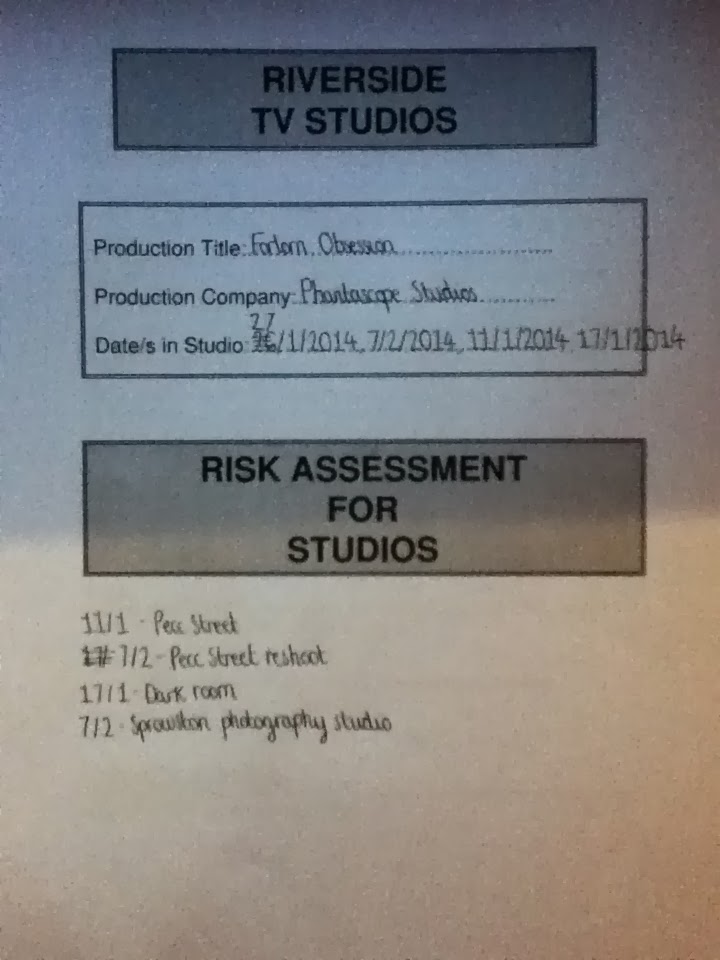
Health and Safety Checklist
Here is the health and safety check list I have carried out for all shoot locations:


Tuesday, 11 February 2014
Reshooting One Scene on Pecc Street
After evaluating our footage with the focus group and with Morrighan, we decided that the errors we found in continuity and camera quality for the scene on Pecc Street require reshooting. I have identified and evaluated these errors using Slideshare to present them:
Monday, 10 February 2014
Monologue
After planning the monologue and music with Morrighan which she has written the post on here, I began writing the monologue to accompany our OTS footage.
5.6s: This creates an enigma, so that the audience become engaged immediately. 'Watching her' links to the stalker images of her in the montage. The audience doesn't see who is narrating, creating a dystopian and disturbed feel. Tone should be slow, soft and upset.
7s: Audience sees part of the character who is narrating. He does not explain how he has 'let her slip', therefore maintaining the enigma created in the first shot. The word 'slip' compliments the tilt down camera angle, making the monologue and shot fluid/flow together. Short sentence to create suspense for how she died, and prepares audience for the flashback scene as they are able to concentrate on the film rather than the monologue.
The audience establishes who the femme fatale character is, and the bullet wound in her chest suggests that she was murdered using a gun. They also establish that the narrator is the anti-hero character, as he is mourning her death and admiring her; presenting him as gentle and eliminates the possibility of him being a traditional film noir villain. Focuses on the narrator admiring her, as this scene is composed of still images of the femme fatale.
Begins to explain the direction of the narrative for the rest of the film. Further expands on the anti-hero's stalking 'I've studied her routine everyday; it's 8:57...' This precision and unhealthy obsessiveness creates an uneasy feel for the audience, and they learn his obsession is one of his main flaws as an anti-hero. This also relates to the film title 'Forlorn Obsession'. The tone should be determined and frustrated. There is no admiration as he is in real time rather than his flashback, and therefore has to face the present reality which he is reminded of as he develops the photographs of the dead femme fatale.
The last word of this sentence will finish as the flashback begins. 'Imagining' signifies the beginning of the flashback and the sentence explains what it is a flashback of, and the short sentence creates suspense. The audience knows that the anti-hero does not see the same accurate flashback as them, as he does is unaware of who murdered her, 'I won't stop imagining how it happened until I know'. The monologue ends here, as the sound accompanying the scene explaining how the femme fatale was murdered will consist of tension building music so that the audience's attention is undivided. This last sentence is powerful at creating an enigma for the rest of the narrative, as the audience wonders if the anti-hero will discover how she was murdered. Due to his narration, they may also empathise with him, and therefore want him to prevail at finding justice - engaging them.
Morrighan has formatted the monologue into a script which is easy for our actor to read: http://www.plotbot.com/screenplays/forlonobsession/screenplay
 |
| "How could I have allowed this to happen. I've been been devoted to watching her - [slight anger] always." |
 |
| "How could I have let her slip." |
 |
| "I found time alone with her while I was photographing for the article on her death. I've always longed to be this close to her, but not like this. I only wish it didn't feel so real; that none of this was real." |
Longer sentences as he is narrating a flashback which has already happened, therefore it is easier for him to express the emotions he'd already felt. In past tense to show that it is a flashback. Expands on how he has been stalking her, 'I've always longed to be this close to her'. His character is revealed to the audience as they see his face, and also learn his occupation as a journalist; 'I was photographing for the article on her death.' His emotions are still the main focus of presentation, as he is the focal point of these shots.
 |
| "Even with her tattoos of dried blood, she was more beautiful in person than I've ever dreamed her to be. No photograph or desiring thought could do her justice. However I cannot escape the reality that she's gone." |
 |
| "I can't rely on the cops to make her murderer pay. They don't know her like I do. They don't care about her. The only way she can be requited is if I find him myself. I've studied her routine everyday; it's 8:57pm and all I want is to see her walking past my window." |
 |
| "I won't stop imaging how it happened until I know." |
Morrighan has formatted the monologue into a script which is easy for our actor to read: http://www.plotbot.com/screenplays/forlonobsession/screenplay
Friday, 7 February 2014
Shoot 3 Evidence: Reshooting Dark Room Scene
Images of the studio where we set up the mise en scene for the dark room scene. We re-printed the images for the wall montage and pinned them to the wall, but used the same developed photographs of the femme fatale's body for the drying line on the wall.


Thursday, 30 January 2014
Second Rough Cut
After evaluating the first rough cut and receiving feedback from our focus group, we re-filmed the dark room scene and edited some of the errors with continuity for the Pecc Street scene, including cutting and cropping the car out of one of the shots with the anti-hero looking at the body.
Before:

After cutting shorter and cropping the top of the shot:

Here is the second rough cut of our OTS with the revised changes:
For the next edit, we will be adding the names of the cast, director, producer, film title, as well as all non-diegetic sound including foleying, music, dialogue and the monologue. We will also refine some of the editing including speeds, contrast, cutting, and transitions. We aim record, edit and add all of the non-diegetic sound to our OTS by next week. We will add text to the OTS after this.
Before:
After cutting shorter and cropping the top of the shot:
Here is the second rough cut of our OTS with the revised changes:
For the next edit, we will be adding the names of the cast, director, producer, film title, as well as all non-diegetic sound including foleying, music, dialogue and the monologue. We will also refine some of the editing including speeds, contrast, cutting, and transitions. We aim record, edit and add all of the non-diegetic sound to our OTS by next week. We will add text to the OTS after this.
Wednesday, 29 January 2014
Title Font Research
Morrighan and I have been compiling research of possible font styles to use for our opening sequence film title. Between us, we have been looking at authentic title fonts from traditional film noirs, neo noirs and other fonts in the film noir style. The fonts used for traditional film noir film titles are generally narrow, rectangular, capitalised, and bold. They are in light colours which contrast the dark backgrounds, and are very large in the centre of the screen.
We also considered designing our own font, and I have found a website which allows you to do this.
http://www.myscriptfont.com
I also found a tutorial of how to use this website:
Film noir/neo noir style fonts which we have researched:
We also considered designing our own font, and I have found a website which allows you to do this.
http://www.myscriptfont.com
I also found a tutorial of how to use this website:
Film noir/neo noir style fonts which we have researched:
 |
| Film noir style song title font from Spica music video |
 |
| Film titles from traditional film noir and neo noir opening sequences |
Thursday, 23 January 2014
First Edit of Final Footage: Focus Group Feedback
Feedback On First Cut from morrighan humpleby on Vimeo
Morrighan and I presented the first edit of our final footage to our focus group to find out;
- If there were any errors of continuity that we had not noticed ourselves, so that we can amend them.
- If the final footage of our opening sequence is in keeping with the traditional film noir style/genre.
- If there were any camera angles/shots that they liked especially, so that we will keep them throughout our edits.
- If there were any camera angles/shots that they felt did not work well for our opening sequence, so that we will consider editing them out and replacing them with better footage.
- If the narrative was easy to follow. (We had asked the focus group this in our previous presentation, however due to the changes and improvements we have made since then, we wanted to be sure that this did not complicate the narrative so that it became difficult to follow.)
Evaluation of Feedback
From this presentation, we found that the focus group were satisfied with the idea of a monologue layered over our footage to explain the story, as no criticisms were raised from this plan. One issue raised by the focus group was the shakiness of the camera during the pan down to birds eye view shot on Pecc Street. Morrighan and I had also previously noticed this, and have applied a steadiness action on iMovie. However as this did not make much of an improvement, Morrighan is locating the additional takes of this shot that I filmed, so that we can look for the steadiest version, and replace the shaky one. It was helpful to know if the shakiness was detectable by an audience, as now Morrighan and I know it is important that we replace it.
An issue which we did not detect ourselves was the lack of fluidity with the transitions of the first and last shots. Our production company title was also accidently timed for too long so that it continued onto the first shot. We have fixed this since the presentation, however this mistake has encouraged us to study our edited footage more carefully before presenting and uploading it so that errors like this do not appear again. To make the first and last shots more fluid, we will apply a fade transition to the first shot, as this can be soft as the tension has not begun to build yet at this point. The transition for the last shot should be more abrupt and quicker than the first transition, as it is the most dramatic shot of the opening sequence; when the femme fatale is murdered. The shot should also be quick as a foley generated gun shot sound will play in time with the transition, and as gun shots are quick and rapid, the transition which accompanies it should be too. Therefore, the transition should be a quick cut to black, as this also signifies the femme fatale's death, as black is what she will see when she dies, and it is a colour related to death/mourning. The title should then fade slowly from black, as this continues the theme of mourning and contrasts the quick shots during the tension building, now that the suspense has ended.
The focus group felt that the narrative made sense and were able to follow it, which was helpful feedback as Morrighan and I needed to check that the changes we made to the opening sequence since the rehearsal footage did not over-complicate the narrative. The focus group also liked the canted still images that I photographed and Morrighan edited of the dead femme fatale. Because no issues were raised with the speed, transitions between them, or amount of images, Morrighan and I will make little to no changes to them. Finally, the panoramic shot of the wall montage could have been cut shorter, as the take is prolonged at the end. Since then I have made this change.
Our next focus group presentations will be to receive feedback on the re-shot footage and improvements/changes we have made to our opening sequence after self and focus group evaluation. We will also present our music, monologue and foley sound effects to the focus group after we record and add them to the footage to see how it is received by an audience, and to identify any necessary changes.
"Text taken from Morrighan's blog: Me and Courtney also filmed one student in the classes feedback about the footage. We didn't plan to, however when I was editing the first feedback video, she came over and complimented our work however said that the dark room scene let it down a bit, so I decided to film her and ask only her some questions. We took this as an opportunity to ask her questions we didn't think of, or forgot to to ask the first group of people. Though she isn't our main target audience it didn't matter too much as it was only about the filming and if the narrative makes sense. We will later do an interview with a few people that are the main target audience to check they like it and if it needs any changes."
"Text taken from Morrighan's blog: Me and Courtney also filmed one student in the classes feedback about the footage. We didn't plan to, however when I was editing the first feedback video, she came over and complimented our work however said that the dark room scene let it down a bit, so I decided to film her and ask only her some questions. We took this as an opportunity to ask her questions we didn't think of, or forgot to to ask the first group of people. Though she isn't our main target audience it didn't matter too much as it was only about the filming and if the narrative makes sense. We will later do an interview with a few people that are the main target audience to check they like it and if it needs any changes."
Wednesday, 22 January 2014
Updated Shot by Shot List
After evaluating our rehearsal OTS, Morrighan and I made changes to the previous shots we used, which we discussed changing in this video. We made a list of all of the shots that we would use for our final OTS footage which we took to our shoot.
After our first rough edit, Morrighan and I spent a media studies lesson together making an updated list with all of the finalised shots that we used. Morrighan then presented this using Slideshare:
After our first rough edit, Morrighan and I spent a media studies lesson together making an updated list with all of the finalised shots that we used. Morrighan then presented this using Slideshare:
Monday, 20 January 2014
First Rough Cut
Rough Rough Cut from Courtney O'Donnell on Vimeo.
This is the first rough cut of our OTS. We have filmed all of our scenes, however I have noticed some errors with the footage, which I have evaluated here:
http://codonnellasmediaproductionschs2014.blogspot.co.uk/2014/01/first-edit-of-final-footage-criticisms.html
Overall, I think that the non-linear order of scenes is very effective and has been presented in a clear way due to the editing transitions we have used to present flashbacks. I am especially pleased with the wide variety of shots we have used, as they keep the OTS interesting and professional looking. The acting, cast, and costume presents the traditional film noir characters conventionally, and most of the mise en scene is appropriate for the film noir era. The only issues are with some modern mise en scene and locations, and with the shaky camera operating. We will present this rough cut to our focus group for them to review and give us constructive feedback.
First Edit of Final Footage: Criticisms
During the first edit of our final footage we noticed some issues with our mise en scene and steadiness of our shots.
Modern Plug Socket
The first issue we found was with the mise en scene used for the dark room scene, as our film is set in the 1940/50s, yet a modern plug socket takes up most of a shot. This modern object is very noticeable in the shot due to the high contrast of the white plug socket against the shadowy room; which draws attention away from the developing tank which we are filming to a flaw in our mise en scene, making the shot less relevant and authentic to its era. We have discussed this problem with our teacher and have decided to reshoot this scene.

Screenshot of plug socket in scene

I researched 1940/50s plug sockets which were appropriate for our era
Whiteboard
In another shot within the dark room scene, the large dry erase whiteboard in the dark room is visible. I researched when dry erase whiteboards were introduced to the UK to see if it was within the era our opening sequence is set, but found that it dates to the late 1950s and early 1960s. As our opening sequence is set between 1940/ early 1950s, to include the whiteboard would make our mise en scene inaccurate.
Modern Car
Another recognised continuity error was a modern car passing in the background of a shot from the Pecc Street scene. As the car is so modern, it would not be seen during the 1940/50s, and therefore must not be in our opening sequence. However, a re-shoot was not required for this error, as I filmed multiple takes of this shot, which I have replaced this with. Because Morrighan and I liked the acting and camera angle for this particular shot, I also cut and cropped out the car continuity error, so that the footage could still be used for our opening sequence.
Screenshot of car in the background of Pecc Street scene
Instruction Posters
We noticed that the very visible A4 posters with instructions for the students who use the school dark room to follow were unrealistic for this scene. Although they are not unsuitable for the 1940/50s, we decided that a journalist who captures and develops photographs for an occupation would not need instructions to remind him how to do his job; therefore making the posters unnecessary and creating discontinuity for the mise en scene against the narrative. This is just one of the factors that have encouraged our decision to re-shoot the dark room scene.
As we have noticed so many important continuity errors with mise en scene, we feel that a re-shoot to amend them is definitely required, as our current footage for this scene is not at all accurate enough with our mise en scene. For our re-shoot of this scene, we will be filming in a new location - the photography studio. We have chosen this location because:
Modern Plug Socket
The first issue we found was with the mise en scene used for the dark room scene, as our film is set in the 1940/50s, yet a modern plug socket takes up most of a shot. This modern object is very noticeable in the shot due to the high contrast of the white plug socket against the shadowy room; which draws attention away from the developing tank which we are filming to a flaw in our mise en scene, making the shot less relevant and authentic to its era. We have discussed this problem with our teacher and have decided to reshoot this scene.
Screenshot of plug socket in scene
I researched 1940/50s plug sockets which were appropriate for our era
Whiteboard
In another shot within the dark room scene, the large dry erase whiteboard in the dark room is visible. I researched when dry erase whiteboards were introduced to the UK to see if it was within the era our opening sequence is set, but found that it dates to the late 1950s and early 1960s. As our opening sequence is set between 1940/ early 1950s, to include the whiteboard would make our mise en scene inaccurate.
Modern Car
Another recognised continuity error was a modern car passing in the background of a shot from the Pecc Street scene. As the car is so modern, it would not be seen during the 1940/50s, and therefore must not be in our opening sequence. However, a re-shoot was not required for this error, as I filmed multiple takes of this shot, which I have replaced this with. Because Morrighan and I liked the acting and camera angle for this particular shot, I also cut and cropped out the car continuity error, so that the footage could still be used for our opening sequence.
Screenshot of car in the background of Pecc Street scene
Instruction Posters
We noticed that the very visible A4 posters with instructions for the students who use the school dark room to follow were unrealistic for this scene. Although they are not unsuitable for the 1940/50s, we decided that a journalist who captures and develops photographs for an occupation would not need instructions to remind him how to do his job; therefore making the posters unnecessary and creating discontinuity for the mise en scene against the narrative. This is just one of the factors that have encouraged our decision to re-shoot the dark room scene.
As we have noticed so many important continuity errors with mise en scene, we feel that a re-shoot to amend them is definitely required, as our current footage for this scene is not at all accurate enough with our mise en scene. For our re-shoot of this scene, we will be filming in a new location - the photography studio. We have chosen this location because:
- There are no windows, making is a suitable dark room
- 3 of the walls are completely clear and free from mise en scene interference
- There is special artificial lighting equipment and available (hidden) plug sockets for if we take the dark room's portable red lights to this room
However there is no table/surface within the room to develop the picture, which means we will need to bring this along, as well as a line and clips to dry the photographs, the wall montage, and all necessary developing equipment to lay on the tables.
Steadiness
Another error that we noticed within the footage was the steadiness of the mid to pan down shot where the anti-hero is looking at the montage. The tripod that we were using from the photography department (where we were filming) did not have a panning lever or very high legs. Therefore to try and keep the camera steady, I held the tripod raised so that it was high enough to film the anti-hero's upper body, and tilted the tripod manually. After watching the footage during our first edit, we found that the pan down is diagonal rather than straight as a result of the difficult tripod we used. This is a different shot from the straight pan down shot which follows it in the next scene. So that these two shots are fluid, we will bring a tripod with a panning lever to the re-shoot; enabling us to achieve a straight and steady pan down shot.
Sunday, 19 January 2014
Progress Timeline
Morrighan and I have created a timeline together using Prezi to organise and schedule our progress in producing our opening sequence. We have been referring to the timeline throughout production, as well as editing it by adding and removing necessary/unnecessary steps. This will ensure that we use our time sensibly and efficiently to prioritise the most important steps of production. The timeline also allows us to check if we are working on time to finish our project by our deadline, as we have created individual deadline dates for ourselves. This will allow us to notice if we are falling behind in our progress, so that we can amend this.
Saturday, 18 January 2014
Costume and Mise en Scene Outcomes
Morrighan and I spent the morning-early afternoon styling our actors with costume, hair, make-up, special effects and their mise en scene, for our first shoot on Pecc Street. I photographed the actors in their full costume, and Morrighan edited these with a black and white filter to show the final film noir style look.
Styling Before First Shoot on Pecc Street
Here is the evidence from before our final footage shooting for the Pecc Street scene, where we are styling the actors in costume, hair, make-up, and special effects.
 |
| Morrighan curling her hair for her femme fatale role |
 |
| Andrew testing the wound special effects |
 |
| Using tissue paper, liquid latex, and foundation |
 |
| Me doing Morrighan's femme fatale make-up |
 |
| Andrew wearing his anti-hero costume |
Thursday, 16 January 2014
Focus Group Feedback
Unfortunately, due to technical difficulties with our camera, the footage that we shot of our focus group watching, asking questions and giving feedback to our opening sequence rehearsal was not recorded. This is a screenshot from the 30 seconds of footage that did record at the end of our presentation to the focus group.

Presenting our opening sequence to the focus group
We presented this final edit of our rehearsal; improved with editing transitions, our production logo and our film title.
Morrighan And Courtney Practice from Courtney O'Donnell on Vimeo
Some of the main questions that we asked the focus group after they watched the opening sequence were:
1. Was the narrative of the opening sequence understandable and easy to follow?
Response: They all understood the basis of the narrative and could distinguish each character's traditional film noir role; the femme fatale, anti-hero and villain.
2. Were the camera angles and editing transitions interesting and fluid?
Response: The scene where the villain follows the femme fatale was uninteresting due to the overly long tracking shot and lack of interesting shots. There were no issues raised with our editing transitions.
3. Overall, is the opening sequence conventional to the traditional 1940/50s film noir style?
Response: With the mise en scene and costumes that we specified for the final opening sequence footage, it will meet the traditional film noir conventions.
4. Which BBFC age rating should our opening sequence be classified as?
Response: The majority of the class said 12A would be the most appropriate rating, however one person said it should be a 15 due to the wound we will be showing.
Upon evaluating the feedback, Morrighan and I agreed with most of the responses, as we also feel that the tracking shot in last scene is too long, that the opening sequence should be classified as a 12A, and that our range of shots should be expanded. It was helpful to receive feedback on whether the narrative was easy to follow and if the opening sequence was conventional to traditional film noir, as these were the possible problems that we were worried we may have needed to solve. Conferring with the focus group was an effective way of answering our questions and getting a practice reaction of the opening sequence as a whole from a real audience. It would have been much easier to reflect on our feedback if the camera had filmed properly, or if we had taken notes from the presentation/given out a questionnaire; however despite these hindrances, the focus group still responded with little feedback for Morrighan and I to reflect on. This suggests that this way of presenting may not have been the most effective way to encourage responses. We will consider other methods of asking for feedback for our next focus group presentation.
Presenting our opening sequence to the focus group
We presented this final edit of our rehearsal; improved with editing transitions, our production logo and our film title.
Morrighan And Courtney Practice from Courtney O'Donnell on Vimeo
Some of the main questions that we asked the focus group after they watched the opening sequence were:
1. Was the narrative of the opening sequence understandable and easy to follow?
Response: They all understood the basis of the narrative and could distinguish each character's traditional film noir role; the femme fatale, anti-hero and villain.
2. Were the camera angles and editing transitions interesting and fluid?
Response: The scene where the villain follows the femme fatale was uninteresting due to the overly long tracking shot and lack of interesting shots. There were no issues raised with our editing transitions.
3. Overall, is the opening sequence conventional to the traditional 1940/50s film noir style?
Response: With the mise en scene and costumes that we specified for the final opening sequence footage, it will meet the traditional film noir conventions.
4. Which BBFC age rating should our opening sequence be classified as?
Response: The majority of the class said 12A would be the most appropriate rating, however one person said it should be a 15 due to the wound we will be showing.
Upon evaluating the feedback, Morrighan and I agreed with most of the responses, as we also feel that the tracking shot in last scene is too long, that the opening sequence should be classified as a 12A, and that our range of shots should be expanded. It was helpful to receive feedback on whether the narrative was easy to follow and if the opening sequence was conventional to traditional film noir, as these were the possible problems that we were worried we may have needed to solve. Conferring with the focus group was an effective way of answering our questions and getting a practice reaction of the opening sequence as a whole from a real audience. It would have been much easier to reflect on our feedback if the camera had filmed properly, or if we had taken notes from the presentation/given out a questionnaire; however despite these hindrances, the focus group still responded with little feedback for Morrighan and I to reflect on. This suggests that this way of presenting may not have been the most effective way to encourage responses. We will consider other methods of asking for feedback for our next focus group presentation.
Saturday, 11 January 2014
First Shoot
Today Morrighan and I are filming our first shoot, which includes the two scenes on Pecc Street. The cast and crew for this shoot are;
Me: Camera operator and director.
Morrighan: Actress playing the femme fatale.
Andrew: Actor playing the anti-hero. Will assist with camera operating when not in shot.
James: Actor playing the villain. Will also assist with camera operating when not in shot.
As Morrighan is acting in almost all shots for this scene, she will not be able to assist with camera operating or directing. However as she is executive cinematographer, I will flip the screen of the video camera of some shots to check their cinematic quality.
Morrighan and our other actors are arriving in the morning-early afternoon, so that we can finish styling the actors in time for shooting in daytime. The materials that I have prepared for this are;
Me: Camera operator and director.
Morrighan: Actress playing the femme fatale.
Andrew: Actor playing the anti-hero. Will assist with camera operating when not in shot.
James: Actor playing the villain. Will also assist with camera operating when not in shot.
As Morrighan is acting in almost all shots for this scene, she will not be able to assist with camera operating or directing. However as she is executive cinematographer, I will flip the screen of the video camera of some shots to check their cinematic quality.
Morrighan and our other actors are arriving in the morning-early afternoon, so that we can finish styling the actors in time for shooting in daytime. The materials that I have prepared for this are;
- Femme fatale make-up
- Fake blood for the femme fatale bullet wound
- Femme fatale handbag and jewellery
We aim to shoot the final footage of the scenes of the femme fatale's death and the anti-hero photographing the body. I will also be taking still images of the femme fatale to edit into the anti-hero photographing the body scene. Morrighan and I are quite confident that this shoot will be successful due to our planning of our shots, mise en scene, and location, and also the rehearsal shoot that we created at the same location on Pecc Street, which made us familiar with where we are shooting and how we will shoot it.
In a media lesson together, Morrighan and I planned the shots that we will be using for all of the scenes for our OTS. Here is the list:
In a media lesson together, Morrighan and I planned the shots that we will be using for all of the scenes for our OTS. Here is the list:
- Pan right, close up of montage on wall
- Mid pan down behind anti-hero, fade black
- Mid Pan down, stops at birdseye view
- Establishing long shot of anti-hero next to body
- Close-up, low angle, looking up at anti-hero
- Tilt up as anti-hero stands up
- Mid shot of villain in the right third
- Canted angles for photographs
- Close-up birdseye view of photograph in water
- Underneath close-up as picture is passed over camera
- Mid static track as anti-hero carries picture to the line
- Zooming close-up to extreme close-up of eye
- Close-up of femme fatale next to river
- Static track as femme fatale walks away
- Long shot of femme fatale walking towards the camera
- Long mid shot of femme fatale walking into shot
- Long shot of femme fatale closer, and then walking out of shot
- Extreme close-up femme fatale smoking
- Extreme close-up, match on action, cigarette falls to floor
- Close-up of villain walking
- Static shot as villain walks away
- Mid of femme fatale walking
- Static mid shot of villain walking in and out of shot
- Mid shot of villain catching up with the femme fatale
- Close-up of villain's hand on femme fatale's shoulder
- Mid behind shot of femme fatale against the wall
- Close-up of femme fatale's face as she speaks
Friday, 10 January 2014
Analysis and Comparison of L.A. Confidential and Memento to our own Opening Sequence
As Morrighan and I have created a very complex narrative, our teacher suggested that we compare ours to film noir films with similarly complicated narratives to analyse how they present their narrative and characters in a way which is easy to follow. She suggested the research the films L.A. Confidential (which I have analysed/compared) and Memento (which Morrighan has analysed and compared).
L.A. Confidential analysis and comparison:
Memento analysis and comparison:
From this research, I have gained more confidence in presenting a complicated narrative and characters, and we will consider presenting them in a similar way to these films. As L.A. Confidential has quite an ambiguous opening sequence due to the use of a montage which is irrelevant at times, and a monologue which can be misleading, yet still manages to introduce its complicated narrative, I no longer think that our opening sequence should be more explanatory, as it would be unnecessary for our audience and would lessen the enigma we are creating. I am pleased that there are many similarities with the clips of our opening sequence and L.A. Confidential's, as this could be interpreted as intertextuality, making the opening sequence more interesting, and also shows that it is a professional way of presenting the opening sequence.
L.A. Confidential analysis and comparison:
Memento analysis and comparison:
From this research, I have gained more confidence in presenting a complicated narrative and characters, and we will consider presenting them in a similar way to these films. As L.A. Confidential has quite an ambiguous opening sequence due to the use of a montage which is irrelevant at times, and a monologue which can be misleading, yet still manages to introduce its complicated narrative, I no longer think that our opening sequence should be more explanatory, as it would be unnecessary for our audience and would lessen the enigma we are creating. I am pleased that there are many similarities with the clips of our opening sequence and L.A. Confidential's, as this could be interpreted as intertextuality, making the opening sequence more interesting, and also shows that it is a professional way of presenting the opening sequence.
Friday, 3 January 2014
Special Effects: Fake Wound
To create the fake blood and wound for our femme fatale after she is shot in the chest by the villain and photographed on Pecc Street by the anti-hero, I have been researched tutorial videos demonstrating the techniques used for making this type of special effect.
The main materials used to create fake wounds and blood are:
The main materials used to create fake wounds and blood are:
- Wax
- Liquid latex
- Food colouring
- Make-up
- Tissue paper
- Spirit gum
Subscribe to:
Posts (Atom)