Wednesday, 30 October 2013

Research Textual Analysis

Double Indemnity, 1944
  • Director: Billy Wilder
  • Set in 1938
  • Film noir genre
  • Based on the 1943 novella of the same name by James M Cain
  • Nominated for 7 academy awards but did not win any
  • Citied as a paradigmatic film noir and set the standards for this genre
  • Stars Fred MacMurray, Barbara Stanwyck and Edward G Robinson
  • Budget of $980 000 and box office of $5 000 000

Plot: An insurance rep lets himself be talked into a murder/insurance fraud scheme that arouses an insurance investigator's suspicions.

Narrative:
In 1938, Walter Neff (Fred MacMurray), an experienced salesman of the Pacific All Risk Insurance Co., meets the seductive wife of one of his clients, Phyllis Dietrichson (Barbara Stanwyck), and they have an affair. Phyllis proposes to kill her husband to receive the proceeds of an accident insurance policy and Walter devises a scheme to receive twice the amount based on a double indemnity clause.

Trailer:


OTS:


Reviews:

Quotes:
Walter Neff: "Yes, I killed him. I killed him for money - and a woman - and I didn't get the money and I didn't get the woman. Pretty, isn't it?"
"Suddenly it came over me that everything would go wrong. It sounds crazy, Keyes, but it's true, so help me. I couldn't hear my own footsteps. It was the walk of a dead man."

Tuesday, 22 October 2013

Understanding Narrative Theory


I have made this Prezi to present the different types of narrative code with examples of films with narratives which follow each code.

Roland Barthes' action codes:
Barthes believed that a story is created by one action leading to another. This narrative style allows the audience to know how things occurred.

Roland Barthes' enigma codes:
On the other hand Bathes raises the idea that it can be mysteries which drives a story forward and interests the audience to watch and work out why something is happening within the narrative.

Tzvetan Todorov:
Todorov stated that narratives are led by events in a cause and effect format, in the structure of a character disrupting the equilibrium (cause), and then begins a quest to restore the equilibrium (effect). He suggested that the primary function of a narrative was to solve a problem, and that a character should follow a series of linear stages to do so.

Vladimir Propp:
Propp is concerned with the relationship between narrative and characters, and argued that stories are character driven, and that plots develop around the actions of the characters. He stated that it was possible to group characters and actions into roles and functions which move the story along. Examples of these characters roles are the hero who has a mission to accomplish something, and the villain who is driven by evil motives and tries to prevent the hero from accomplishing their mission.

Claude Levi-Strauss binary oppositions:
Levi-Strauss argued that all construction of meaning was dependent, to some extent, on oppositions such as light-dark, hero-villain, and man-machine.

Sunday, 20 October 2013

Intertexuality

Intertexuality in film is the reference to other famous and iconic works of film, photography, literature, and television, within a film outside of these works. Some intertextuality references are subtle and discrete, therefore they can become unnoticed by people who are less educated with media. I found that this video provided a clear understanding of the term with examples of intertextuality within film and television:


As I am creating my OTS film for a post-modernist audience who are interested in film noir, I will consider using intertextuality references to other traditional film noir works, as an audience educated with this genre will be most likely to spot and appreciate them.

Saturday, 19 October 2013

Film Noir Conventions

These videos effectively present the key conventions of film noir films:


After analysing these videos, I have researched that the key conventions for traditional film noir are:

Themes and hyrbid-genres: Crime, detective, drama, action, romance, gang violence.
Characters, costume and mise en scene: The main characters are the anti-hero, femme fatale, villain, redemptive woman, and gang members/leader. The characters usually promote smoking, carry pistols, and are dressed in suits and fedoras, or seductive clothing for the women (especially the femme fatale).
Setting: Urban cities, and some rural settings. America (where film noir originates), dystopian rain, smokey alleyways and police officer rooms.
Lighting: Use of chiaroscuro (strong contrast between light and dark), barn lighting which projects a strip of light imitating the film noir blind filters - which are another convention. Black and white filters and lots of shadows and silhouettes.

Conventions explained in greater depth in this post: http://codonnellasmediaproductionschs2014.blogspot.co.uk/2013/10/film-noir-genre.html

Deconstructing an OTS

I have analysed and deconstructed the opening sequence of the the 200-2005 American black-comedy, drama television series; Six Feet Under. I used Art of the Title to watch the show's opening sequence, and then presented my deconstruction using Screencast-O-Matic. This deconstruction has helped me to recognise conventions of opening sequences, and become more familiar with them for when I begin creating my own OTS.


http://www.imdb.com/title/tt0248654

Six Feet Under (2001) Poster

Friday, 18 October 2013

Film Noir Genre

Film noir began in the late 1930s and remained a strong cinematic medium until the early 1960s. Film noir translates to 'black film' from French, and features negative themes, with an overall dark, shadowy and dystopian outlook, as well as being filmed in black and white. The narrative of this genre takes in detective and crime noir, as well as many ganster films in the 1930s, and also transgresses into more modern films of hybrid genres. These hybrid genres include;

Western noir:

'High Noon', 1952

Romance noir:

'Laura', 1944

Crime noir:

'The Big Heat', 1953

Detective noir:

'LA Confidential', 1997

'LA Confidential' is an example of the neo noir genre, which is a modern adaptation of film noir, as it translates to 'new black' from French. This genre is often seen in modern motion pictures and other forms that prominently utilise elements of film noir, but with updated themes, content, style, visual elements or media that were absent in films noir of the 1940s and 1950s.

Noir scenes are made from interesting camera angles and with dramatic close-ups and shadowed lighting. Smoke-filled rooms, light filtered through venetian blinds, seedy downtown areas with neon lights, and dark, wet, unsettling streets are frequently used to heighten the noir effect. Brightly lit scenes are not used in noir films since the desired effect is that of dreary hopelessness.

The characters of noir films include the main flawed protagonist, who is predominantly male. His flaw, which may be crime, adultery or weak-will etc, brings him to ruin, and he may become tainted by a dishonest deed and sent to his doom. He may also be brought down by a femme fatale character. Many flawed protagonists are detectives, taking the cases of mysterious women who draw them into a tangled maze of evil by making use of their hypnotic sensuality.


The femme fatale is most often portrayed as a beautiful woman who is cruel, dishonest and willing to do anything necessary to reach her ends. She uses the protagonist as a tool to help her accomplish some unsavoury deed, and the protagonist is powerless to refuse her. The distrust that the femme fatale holds for her pawn is also what brings her to destruction, as she is often killed off early in the film.


The redemptive woman is a pure and virtuous contrast to the femme fatale, and only wishes the best for the protagonist. However in this battle with the femme fatale, evil always triumphs. The protagonist is powerless to make the choice of the woman who is best for him.


Flashbacks are another facet of film noir, and are often presented as voiceovers which are narrated by the protagonist recounting, somewhat sarcastically, the reasons and details of his downfall. The plot of a film noir is circuitous and holds many surprises and unanswered questions for the viewer. Sometimes the resolution of the plot is left hanging, casting an even darker aura over the film.

Understanding Genre and Hybrid Genres

Genre
The term genre describes the means of which any media text can be categorised in order to clarify audiences understanding and help institutions target certain markets. Single genres target at new markets, and have smaller film budgets due to their smaller market. Films are catagorised by their similarities in narrative elements including;
  • setting: the environment where the narrative is taking place
  • theme/topic: the theme and concepts which the film revolves around
  • mood: emotional tone of the film
  • format: presentation of the film
  • target audience: the specific audience which the film is aimed for
Examples of genres:

By courtneyodonnell

Audience, Industry and Institution
Active audiences are influenced by genre, as they choose to engage with the media product due to it's genre and their preference of it. This prevents them from being disappointed with the media product. However if the narrative is too typical of its genre they will be less interested. Industries target their media products to the preferred audience of its genre, however they also need to persuade the oppositional audience (people who are against this genre) as they are trying to appeal to the largest potential audience as possible. Reading is how an audience receives the media products, and multiple readers can be taken in different ways.
The institution is broken up into 3 main catagories:
Traditional: The audience are cinema goers who buy DVDs instead of blue-rays or streaming. They choose genres which are familiar and safe. This type institution is used for film noir.
Hedonist: The audience takes risk and are drawn into films which are horrific and shocking.
Postmodern: The audience are intellectual and watch films at art houses. These films may not feature any dialouge and can be sweded. They do not take risks, and experience old films in a new way, which includes streaming.

Hybrid genres are combined genres, and may have evolved over time due to larger film budgets which desire to appeal to a larger audience. Here are some examples of hybrid genres and films of these genres.

By courtneyodonnell

Media Audiences

In class we defined the different types of audiences:


I then went on to research Pete Buckingham, head of distribution and exhibition for the UK Film Council's transcript from a workshop with iFeature regarding audience trends, profiles and patterns.

In industry, the UK cinema-going audience consists of:
1. 40% Young, aged 15-24, despite representing 32% of the population
In contrast, ages 55+ represent 34% of the population but only 20% of the cinema audience. 35-44 year olds represent 35% of the population and 38% of the cinema audience.

2. Upmarket, ABC1s (upper, middle and lower class demographic) represent 49% of the population, but 60% of the cinema audience, which increases up to 66% amongst heavy cinema goers. This trend shows that the older the audience, the more upmarket.

3. Frequency, 15-34 year olds form 60% of the heavy cinema goers, with 40% of them from the 15-24 age group. Medium cinema goers are 50% of 25-44 year olds. The 55+ age group represents 32% of light cinema goers.

From this information, you can analyse that this is a young and upmarket audience. Within the film industry, there is a degree of snobbishness towards the so-called multiplex audiences (multiplexes are somewhere to eat and lots of screens e.g Riverside, Norwich, for its nightclubs, restaurant, and wide variety of film screenings.)

Clusters
Cinema audiences can be clustered to interpret what an audience looks like, and understand how to communicate with them and what they are like. These clusters include:
Hero seeker - Don't go out much, place well in advance.
Impulsive materialist - Fashion victim, affluent, film-dinner-drinks. Word of mouth is key.
Film fanatics - Male, pre-plan their trip, 25-44, go in 2s, review-led.
Impressionable socialites - Male/female, under 25, like blockbusters, led by ads.
Modern parents - Kids pressuring the parents.
Fun lovers - Not film literate, big film and video consumers.
Youth of today - See films as soon as they come out.

However these clusters do not give enough information for writers, directors of producers, as they are so vague and difficult to plan for. Films fall into the categories as opposed to being designed for them.

Generic pleasures
Pete Buckingham asked audiences 'what activities are more important to you than film?' The responses were:
Men: Music, drinking, sport, socialising, TV
Women: Music, socialising, shopping, TV
Younger people: Music, TV, socialising, computer games, shopping

Audience's interest in music
Music is very popular amongst all ages and genders, however it does not align strongly with film. However, most famous films and blockbusters have a memorable soundtrack attached to them, for example the Pulp Fiction soundtrack. This should be considered for many more films, and music is very important to their audiences.

What film represents to an audience
For the majority of general film audiences, film represents satisfying peoples' unfulfilled desires. It includes of the things that people do not get from work;
Excitement, exhilaration, power, fun, ambition, people to admire, creativity, imagination, innovation, style and glamour, the surprising, and the unexpected.

The UK Film Council researched that the biggest thing to come out of the cinema is an event. Since general audiences tend to go to the cinema with at least one other person, there must be negotiation in choosing which film to see. Audience choices are governed by the following what their friend/partner wants to see. This is because people want the film they see to give them a peak experience. They also do not want to be blamed for choosing a bad film, as this would be a waste of money and time. In a group of friends, the films which polarise are unlikely to be chosen, meaning that blockbusters will most likely be seen. There is a desire to have a shared experience, therefore people do not want to choose a film which their company will not enjoy, and most people do not want to go to the cinema alone.

Given people's desire to not make a mistake, but choose quickly and effortlessly, they look for clear signals for if they will like the film. These are drivers (things that draw the person to the film), and barriers (things that push the person away from the film);


My target audience for my OTS film
My own target audience for a traditional film noir film, falling into the crime-drama hybrid genre, is an audience of both males and females. This is because during my research into audience, I found that both females and males shared the same level of interest in the crime/gangster film genre.

I will be targeting my traditional film noir film at a post-modernist audience, as they are most fanatical about film and will appreciate the conventional film noir aspects. They will also be the audience who watches our film at art houses and by streaming (which is how we are distributing), as from my research I found that this audience category ‘experiences the old in new ways’. Due to the adult crime-drama genre for my OTS film, and the traditional late 1940s/early 1950s setting, I will target my audience at an older age, from 25-44. This is because this audience are medium cinema goers, and therefore will be interested in carefully choosing smaller films to watch, rather than going to see every new blockbuster. Older audiences are also more upmarket, and as my film will be shown in art-houses as well as cinemas, this is the audience who will be most likely to choose to watch a film at an art house over a blockbuster at a multiplex.

Wednesday, 16 October 2013

Creating Still Images Using Film Noir Styles

"Film noir is a new cinematic technique that made use of dark or dim lighting effects, dreary settings, filtered lights and generally dark themes and characterizations. Noir scenes are made from interesting camera angles and with dramatic close-ups and shadowed lighting. Frequently the stories use of smoke-filled rooms, views of light filtered through venetian blinds, seedy downtown areas with neon lights, dark wet streets to heighten the noir effect."
My group and I captured and edited a variety of portraits around the school which reflect the moody, melodramatic, shadowed, film noir style.We created shadows and sillhouettes with artificial lighting, and in different locations around the school including the studio for tall plain walls to project light, and a cupboard with a door which had a glass pane to photograph through. We also tried a variation of different poses for our models to bring life to the traditional film noir characters, such as the seductive femme fatale, shady villain, and shaken anti-hero. Finally, we all contributed to bringing our own costume and mise en scene for our character, which included dark, sultry femme fatale costumes and cigarette props, which are conventional to the film noir style.

Below are the portraits that I have edited, compared and contrasted with similar work from other photographers of this style:

Image 1:

This image represents the femme fatale character, as it balances feminity; red lipstick and a delicate expression/pose, with danger; the pistol and heavy shadows. It is more conventional to the neo noir style rather than traditional film noir due to the colours, as I used Photoshop to add a faded black and white filter, but coloured her lips red. The image contrasts power with weakness, as the femme fatale characters are traditionally both empowered and vulnerable. The power is presented by the use of chiaroscuro, with the strong, bold shadows of the pistol which are emphasised against the light wall and her body. Her vulnerability is presented by her worried expression and the handkerchief she is clutching, which creates the image of a 'damsel in distress'.


I have compared my portrait to the pose and character of 'Film Noir Gun Girl' by Kollin Bliss, due to the similarities with the model's style, close-up type of shot, pistol mise en scene, and presentation of the femme fatale character. The image contrasts as Bliss' image is more traditional film noir, whereas my edit is in the neo noir style.

Image 2:

This image represents three traditional film noir characters; the femme fatale, redemptive woman, and villain. The femme fatale is presented conventionally as she is revealing with her costume to reflect her seductiveness, and is shadowed and smoking to present rebelliousness and danger. Her vulnerability is also displayed as she is facing the silhouette of the villian. The femme fatale is contrasted by the redemptive woman, who is lighter to symbolise her purity and innocence. Finally, the villain is presented with a strong silhouette to create mystery, and is much larger than the other characters to display power and strength. Unconventionally, the villain is female (which you can from her silhouette) as we did not have any male members in our group. However the image is conventional to the traditional film noir style due to it's use of chiaroscuro for silhouettes and shadows, and black and white filter.

Monday, 7 October 2013

Les Miserables Sweded

This is the swede of Les Miserables, 2012, which I have independently created after my research on sweded films over the summer.


I have also uploaded my sweded film to YouTube, and this can be found here.

Evaluation
I think that the most successful elements of my sweded film are the range of camera angles and tricks which I used, for example a close-up, zoom of the paper boat, and then a tilt of Jean Valjean far away and dragging it. This creates the illusion that the boat is enlarged by the camera angles and composition. I also used a high angle shot for Jean Valjean lifting the flag, and a mid shot of Javert, who is standing raised above him; presenting Javert's superiority over Jean Valjean. My variation of settings around the house that I was filming at made the film more realistic and interesting for the audience.

Using a red cardigan to symbolise the blood from an injury and creating the barricade using household equipment are examples of the creative mise en scene that I used. However I was disappointed that I did not create more props for my film, as I feel that area may have been lacking. If I made my sweded film again I would also use more distinct costumes for my characters, or consider using more actors, as my characters are not easily distinguishable, which may be an issue for my audience when I present it to the class. Finally, I would also experiment with using more sound, such as sound effects for the barricade to play alongside the injury reactions, or music as it is a musical film.

In comparison to the idea of sweding films, I think that my film has met the criteria as;

  • Les Miserables is a film within the last 35 years
  • It is an armature recreation, as this is my first time making a film
  • It mimics my sources material, as the film's narrative, characters and key scenes have been comically adapted
  • I had no budget and all props and costumes were homemade/resources from home, for example the paper boat at the beginning of the film, and the kitchen furniture used to build the barricade
  • No special effects, man-made sounds, or computer generated graphics were used
  • It was between 2-8 minutes long

Class feedback
After presenting my film to the media class, this was the feedback that I received:
  • The characters should dress and act more uniquely, it is hard to distinguish between them
  • I need opening and end credits
  • More sound could be added
I will consider this feedback and my own self criticism if I make another final edit of my sweded film.

Saturday, 28 September 2013

Sweded Film Planning

After researching other sweded films over the summer holidays, I have decided to swede the historical-musical film, Les Miserables. I am very familiar with this film as it is one of my favourites, and I own the film on DVD, therefore will be able to refer it throughout planning. I have created a storyboard (which I have also made into an animatic) to plan each shot of my film. After creating my animatic, I found that my sweded film will be approximately 2:24 minutes long. I do not plan on using many editing effects and transitions, as I want my sweded film to be as simple and man-made as possible. I have thought about recording music to overlay the footage, however it would be difficult to condense all of the songs into such short scenes, therefore I will just be using diegetic dialogue.

My storyboard with corresponding original film clips


Thursday, 26 September 2013

Original Analysis of 'Coraline'

Opening sequence of 'Coraline'
I have decided to analyse the opening sequence of an animated film to see how this differs from the opening sequence of a live action film.

1. Production Company
The opening sequence of the 2009 American stop-motion 3D horror/fantasy film begins with the name of it's production companies; 'Focus Features', 'Laika Productions', and 'Pandemonium Productions', which meets the key conventions of an opening sequence. The company logos are edited, as the font outline, basic shapes and coloured areas of the logos still the same, but with gothic and eerie sewed style, and the colour scheme of the opening titles. This is unconventional of production company logos for film opening sequences, however the house style makes the opening titles more artistic and sophisticated. The transitioning between them are fades.


2. Film Title
Next the film title is shown, in keeping with the house style but with it's own larger font outline and button graphic to make it distinguishable as the title by standing out from the rest of the opening sequence. It meets the convention of the film title being presented at the beginning of the opening sequence. It is also transitioned by a fading.


3. Main Voice Actors
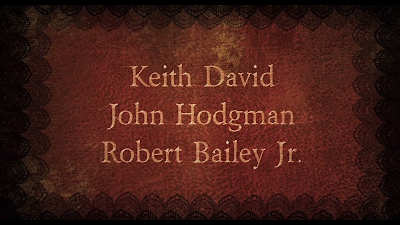
The main voice actors are next to be presented in the opening sequence. They are not introduced by their role which challenges traditional conventions, but as the first voice actress is well known for her role, this is not necessary for the audience to recognise her. These are also transitioned by fading.


The voice actors with less major roles but still main characters in the film are shared between 1 frame so that the opening sequence does not being uninteresting by prolonging it's length, which meets the conventions of opening sequences.


4. Lead Animators
The lead animators are presented alongside the start of an animation of a doll being transformed into a new doll by the spindly, eerie antagonist of 'Coraline', foreshadowing the plot of the film. They are presented alongside this animation to link them to their work. This meets the conventions as this is one of the most major roles in animated films and should therefore be credited at the beginning of the opening sequence.


5. Concept Artist
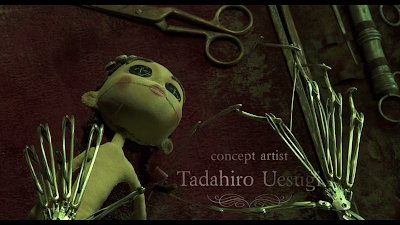
This is a typical convention of opening sequences as the concept artist is a major role in animated films. The background of the case of cutting tools is the same leathery, vintage and wine coloured lining used for the production companies, film title and main voice actors backgrounds, which revisits the house style and explains why that background was chosen. The close up of the thin, spindly metal hands and rusted cutting tools make the audience uncomfortable and spooked, and the fact that we don't see who or what is operating the hands makes the opening sequence suitable for it's horror genre.


6. Art Directors and Storyboard Supervisor
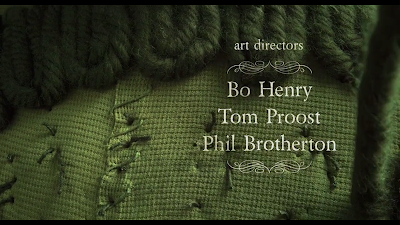
These meet the key conventions of an opening sequence, as they are important roles within the making of the animated film. The audience establishes the doll being undone and the stitching ripped with close ups and extreme close ups, which helps them to begin to understand what the metal hands are doing. However the plot of the film is not obviously revealed and or begun, therefore the conventions of not giving too much of the film away are still met.


7. Editors
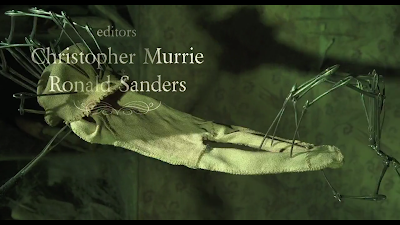
This is a typical convention of opening sequences as editing is a major role within all films. The presentation of this role is the most spooky of all, as the human doll shape is emptied of it's stuffing with a low angle shot, and turned inside out, which leaves a shadow of this on the gothic torn and spiderweb full wallpaper. As shadows and run down houses are associated with horror films, the mise en scene presents the film's genre well, which is conventional of opening sequences as it makes the audience uncomfortable in order to prepare them to be scared.


8. Visual Effects Supervisor, Music, Supervising Animator, Director of Photography, Producers, Author Based On
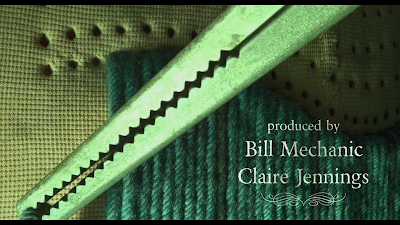
For the rest of the opening title sequence, we see the doll being pieced together, with new button eyes, sand grain/wood chipping stuffing, a new dress etc. The music becomes lighter with soft vocals, and the tools switch from harsh metal to gentler, less dangerous wood, which makes the audience feel more at ease and with what the metal hands are doing. All of the conventions are typical of an opening sequence of an animated film, as they are all main roles, which is why they are credited.


9. Writer/Director
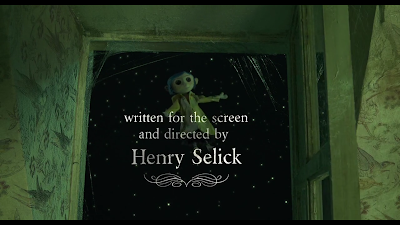
The final convention of the opening sequence of 'Coraline' is the credit to the writer/director, Henry Selick. This is the last convention as the director is seen as the most important role of film making, and therefore should be the last name that the audience remembers. The opening sequence ends as it started, with the completely renovated doll exited the window it entered. The newly decorated doll foreshadows when the doll appears late in the film, and the style of the main character 'Coraline' who they will shortly meet. The original doll is also a character which they will come encounter. This is so the audience will recognise the doll from the opening title sequence, and also be aware of how the dolls are changed to manipulate the characters, helping them to understand the plot and make the opening sequence memorable.


Summary
In conclusion, the opening sequence of 'Coraline' is used to foreshadow the plot and characters of the film, prepare the audience to be spooked by making them uncomfortable with the gothic mise en scene and spindly, mysterious metal hands, cutting and stitching of the doll, and of course give credit to the makers of the film. This is achieved by the use of shadows and close ups/extreme close ups of the painful renovating done to a doll resembling a human, which the audience can feel empathy for.

Saturday, 21 September 2013

Original Analysis of 'Se7en'


1. Production company
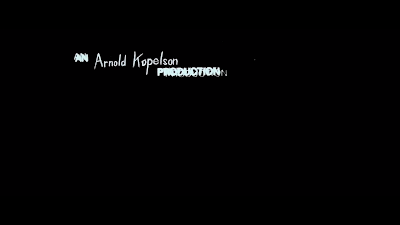
The title sequence of the 1995 American thriller 'Se7en' begins with the name of it's production company, 'New Line Cinema'. It is typical for the production company to be the first convention of an opening title sequence, but this convention is also challenged by director David Fincher, as it is presented with cinematography rather than the traditional presentation using the company's logo.


(Production company)


(Conventional production company logo)

Using cinematography rather than the production company logo is unconventional as it brings less recognition and attention to them, but this is amended by the long shot of the production company name.

2. Producer and Director
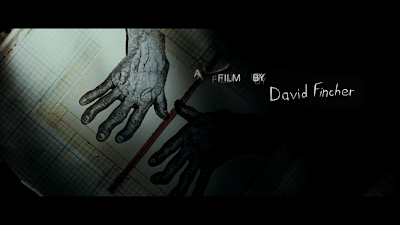
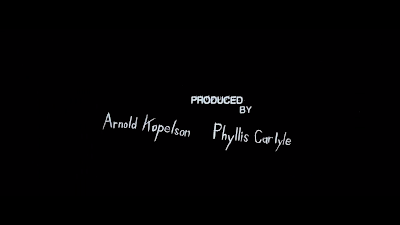
The next conventions are the names of the producer and director of 'Se7en'. These are typical conventions and order of conventions for opening title sequences, as they are important roles which is why they are at the beginning of the opening title sequence.


Unconventionally however, the names of the director and producer are repeated at the end of the opening title sequence to give them more credit and recognition.


3. Main Cast Member Names and Film Title
This typical convention begins without the title 'Cast members' as the first cast member is a well known actor who does not need to be explained for the audience to understand his role.


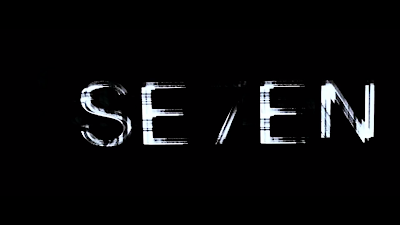
The two main cast members, Brad Pitt and Morgan Freeman are separated from the other cast members by the interruption of the long shot of the film title after their names have been presented and before the other cast names. This foreshadows the first scene after the opening sequence where "it first introduces us to retiring Detective Somerset (Morgan Freeman) and rookie replacement Detective Mills (Brad Pitt) as they also meet for the first time".


The cast names continue after the film title, with the less important cast members of the film sharing one frame; a typical convention of opening title sequences, as the audience discover who the most important main actors are without the opening sequence being too long and therefore uninteresting.


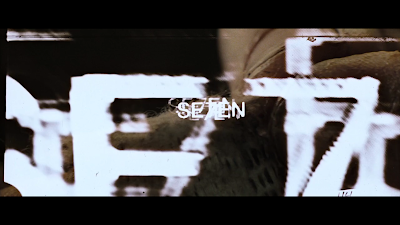
The film title is later repeated in a short shot which is unconventional, but makes it more memorable to the audience.


4. Casting Directors
Presenting the casting directors challenges traditional conventions of opening title sequences, as this role is usually credited in the end credits of the film. This makes the cast of 'Se7en' seem more complexly found and prestigious.


5. Director of Music and Photography and Costumes and Production Designer
Although the director of music and production designer is sometimes a convention of an opening sequence, credit to the costume designer and director of photography challenge traditional opening sequence conventions, as this convention is usually presented in the end credits. These conventions were chosen, as the people behind these roles are well known and award winning in their fields, making them credit worthy. "Memorable score and rich cinematography" The music and cinematography are important components of 'Se7en', which is presented by the opening sequence, and therefore the 8 award nominated photographer, Darius Khondji, and 3 Academy Award winning and composer of 80 film scores including 'Lord Of The Rings', Howard Shore, are notable in the title sequence.


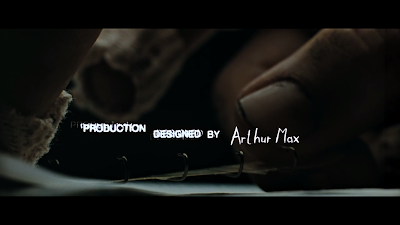
The costume designer, Micheal Kaplan, won a BAFTA for best costume design, and production designer, Arthur Max, won 4 awards for his work in production designing. This also makes their roles notable in the opening title sequence, and as these well known names will be recognisable to some people, it will raise their expectations of 'Se7en' due to other great films these people have contributed to.


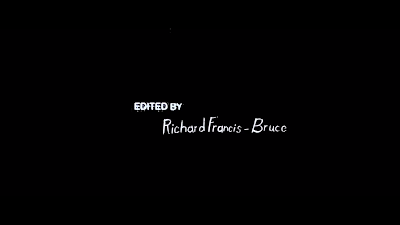
6. Editor
Presenting the editor is a traditional convention of an opening sequence, as it is an important role for all films, especially for films such as 'Se7en' with it's rich cinematography. However the order of conventions is a challenge, as for such an important role, it is quite late in the title sequence.


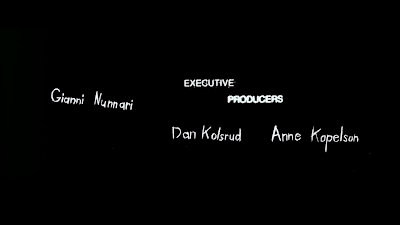
7. Executive, Co-Executive and Co-Producers
This convention is typical of opening title sequences, and the names are shared between 1 frame as they are of equal importance.


8. Writer
The writer is a key and traditional convention, usually at the end of the openings sequence so that it is memorable to the audience, allowing them to recognise this name from other works.


9. Sound
The sound used for this title sequence is the eerie remix of Nine Inch Nails' 'Closer', which sets an uncomfortable and creepy atmosphere for the film with it's crashing, buzzing and droning noises to spook the audience; making 'Se7en' suitable for it's thriller genre.


"The opening sequence is considered one of the most innovative of it's era"
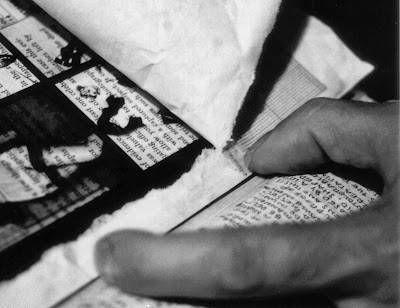
I think that this statement is true, as the opening sequence of 'Se7en' differs to all opening sequences before it. A difference which distinguishes it from other title sequences is it's non-narrative format. The opening sequence portrays the film's killer, John Doe, as he assembles a diary documenting the murders he will be executing in the film. As the killer does not appear until 40 minutes into the film, the titles help to bridge that gap. The face of the killer is also not revealed to maintain suspense. The style of Se7en's opening sequence is new and innovative, "Cooper incorporated the computer to reconcile traditional and modern techniques. In doing so, he revitalized film industry titles and redefined their visual style." This inventive, new style inspired many other opening sequences over the years, having been co-opted almost wholesale by the horror genre as a house style. It has continued to impact the title industry two decades on; not only was 'Se7en' one of the most innovative of it's era, but has maintained it's legacy for following eras.

Wednesday, 11 September 2013

Core Conventions of an Opening Sequence to a Film

These are what I think are the core conventions of an opening sequence to a film:
  • Distributor company name
  • Production company name
  • Title of film
  • Director's name
  • Executive producer's name
  • Editor's name
  • Name of book/play and author if it is based on one of these
  • Main cast members names
  • Film logos Sound -music to set the scene of the film without giving too much away, such as whistling wind and low pitched drums to set a solemn and dull beginning scene, or recognisable theme music. An example of this is the Harry Potter opening music which incorporates sound to set the scene and its memorable theme music:

Identifying the Codes and Conventions of a Film Opening Sequence


4. Conventions of a thriller opening from zubairkhan93

Analysis:

How successful are they at identifying conventions?
The presentations were not all successful at identifying the key conventions of an opening title sequence (OTS), as although they were identified at the beginning of most of the presentations, they were not fully explained therefore I have no learnt why these conventions are used or much about their effect in an OTS. The third presentation 'An Analysis Of The Opening Sequence Of Vertigo' began to explain the effect of the key conventions, however this explanation was specific to the 3 OTSs that were analysed, and would be difficult to apply to the OTSs of other films. The information presented by the first presentation was also unsuccessful, as it seemed uncertain by the prevalent words "sometimes" and "could". This made me unsure of what the definite key conventions actually are. The second presentation however was most successful. It identified the most key conventions compared to the other presentations, and did this in the most appropriate level of detail in explanation. Also, the examples were comparable and could be extracted to analyse other OTSs.

Who is the audience?
The audience for these presentations are media and film studies students who are researching the key conventions of an OTS, film fanatics who are interested in the inner workings and methods behind the composition of OTSs, and young/new film makers researching how to create an OTS for their film.

What is the purpose of the presentations?
The purpose of these presentations is to educate it's audience of the key conventions of an OTS, and analyse the key conventions of the chosen films' OTSs.

Is the format successful?
The 3 presentations which chose Powerpoint as their format were the most successful in my opinion, as the slides were clear to read and extract information from, organised, and interesting with their use of colour, images and brief writing styles. However I found that some of these presentations were too brief; lacking the level of detail necessary to explain the key conventions. The second presentation had the most successful format, as the key conventions were immediately identified at the opening slide, and were analysed throughout the presentation with relevant images taken from films which present them in their OTSs. The information was comparable, as 2 key conventions were presented on one slide. This allowed the audience to compare their effect in an OTS. The third presentation format needed to be sifted and broken down in order to extract relevant information on the key conventions, as it was mostly a detailed analysis of 3 films' OTSs, making it the least successful format.

Did they identify ALL of the conventions accurately?
I do not think that the presentations identified all of the conventions accurately, as most of the presentations identified a different number of key conventions. An explanation of the conventions was lacking in many of the presentations too, therefore they were not presented accurately.

Friday, 6 September 2013

Animatics

An animatic is a series of rough storyboard frames drawn to the planned camera angles, edited together to approximate the finished film and timing between frames, with in some cases, sound and dialogue layered into the animatic. Most professional animatics are created using Photoshop to draw the frames, and edited together using AfterEffects; however for my first animatic, I created my frames by drawing them by hand and edited them together using Windows Movie Maker. Both are effective methods and uses of software for creating animatics, however the first method would more likely be used by a company which specialise in creating animatics, or a high end film production team.


I have created this animatic to plan my sweded film; Sweded Les Miserables. Sound and dialogue would be most effective if the film created was for a music video, with the effect of the frames are in time to the beat of the song. Also if the film has lots of dialogue which has already been scripted and finished. I chose not to add dialogue or sound to my animatic because my frames were widely spaced, therefore the dialogue and sound would be harder to follow in relation to the frames.

Some of my favourite animatic examples include:


This animatic was created using Photoshop and AfterEffects to plan a short film. The frames are detailed with small spaces between them, and there is no sound or dialogue which focuses the planning on the frames. The only colours used are black and white shading, and a maroon/red colour for detail within the film, which makes a clear not of it.


This animatic is created to plan a music video, therefore sound was used to arrange the frames in time with the beat and length of the song. There are also stage directions on the bottom left corner of the frames, to add further detail. The frames are drawn in the angles of the camera angles that it will be shot with, and are medium-lengthed spaced and quite detailed. The setting of the frames is also very detailed, as it is complex and changes between each frame; this organises and determines where each scene will be shot.


Advantages/disadvantages of creating an animatic as opposed to a live action film

Advantages:
  • Cheaper to produce as actors, mise en scene, locations, lighting etc. are not required
  • Easier to remake scenes/shots later, as live action films would need to be set up exactly as before for continuity
  • Can create expensive and imaginative sets and ideas without the need for special effects, e.g. the tall castle and flying scene from the 'Defying Gravity Storyboard' animatic above
  • Can be created over a long period, unlike live action films which are effected by changes in natural lighting and actors
Disadvantages:
  • Live action films are easier to follow if the animatic lacks artistic ability
  • Live action films are more realistic, therefore animatics work better for fantasy films, but worse for more serious genres such as dramas, historical, and documentaries